Loading...
9 Inch vs 12 Inch Auger: When to Use Which Size
Choose the right auger size for your post hole digger - complete comparison guide
Buying Guide
VS
The 9" and 12" augers are the two most popular sizes for post hole diggers in India. Choosing the right size affects productivity, fuel consumption, and suitability for your specific application. This guide helps you understand when to use each size for optimal results.
Quick Comparison
| Feature | 9 Inch (225mm) Auger | 12 Inch (300mm) Auger |
|---|---|---|
| Hole Diameter | 225mm (9 inches) | 300mm (12 inches) |
| HP Required | 35-45 HP | 40-55 HP |
| Holes per Hour | 50-70 | 40-60 |
| Best Application | Wire fencing, light posts | Standard posts, tree planting |
| Fuel Consumption | Lower | Moderate |
| Soil Displacement | ~3.8 liters/hole | ~6.8 liters/hole |
| Weight | 18-22 kg | 25-30 kg |
Detailed Comparison
1Application Suitability
The 9" auger is ideal for barbed wire fencing, chain link posts, vineyard stakes, and light-duty applications where posts are 2-3 inches in diameter. The 12" auger suits standard fence posts, concrete poles, tree planting pits, signboard foundations, and most general agricultural purposes. For most Indian farms, the 12" is the more versatile choice.
2Tractor Power Requirements
The 9" auger works efficiently with 35-45 HP tractors, making it suitable for mini tractors and smaller farm tractors common in India. The 12" auger requires 40-55 HP for optimal performance. If you have a 35-40 HP tractor, start with a 9" auger. For 45+ HP tractors, the 12" auger utilizes the available power better.
3Productivity Comparison
The 9" auger is faster - digging 50-70 holes per hour compared to 40-60 for the 12" auger. This is because it displaces less soil (about 45% less per hole) and requires less power. For large-scale wire fencing projects where hole size is adequate, the 9" auger offers better productivity.
4Operating Costs
The 9" auger consumes approximately 20-25% less fuel per hole due to lower power requirements and less soil displacement. Auger teeth also last longer on the smaller auger. However, if a 9" hole is too small for your posts, the cost savings are irrelevant - choose based on application needs first, then consider costs.
5Soil Condition Performance
In hard or rocky soil, the 9" auger penetrates more easily due to its smaller cutting area. It puts less strain on the tractor and gearbox. The 12" auger may struggle in very hard conditions with lower-HP tractors. For challenging soil, either use a 9" auger or ensure you have adequate tractor power (50+ HP) for the 12".
When to Choose 9 Inch (225mm) Auger
- Wire & Barbed Fencing
Thin metal posts for wire fencing fit perfectly in 9" holes.
- Vineyard & Trellis Systems
Stakes and trellis posts typically need smaller diameter holes.
- Lower HP Tractors (35-40 HP)
Get optimal performance from smaller tractors.
- High-Volume Fencing Projects
Faster digging when 9" diameter is sufficient.
- Hard/Rocky Soil
Easier penetration in difficult soil conditions.
When to Choose 12 Inch (300mm) Auger
- Standard Fence Posts
Concrete, wooden, or 4"+ diameter posts need 12" holes.
- Tree Planting
Fruit trees and saplings need adequate root space.
- Foundation Holes
Signboards, street lights, and construction pillars.
- General Purpose Use
Most versatile size for varied farm applications.
- Solar Panel Installation
Standard mounting structure foundations.
Our Verdict
For most farmers buying their first auger, we recommend the 12" size as it handles the widest range of applications - from fencing to tree planting to construction. The 9" auger is an excellent second auger for those who do significant wire fencing or have lower-HP tractors. Many experienced farmers own both sizes to match the auger to each job. If budget allows only one auger, choose 12" for versatility.
Frequently Asked Questions
Can I use both sizes on the same digger?
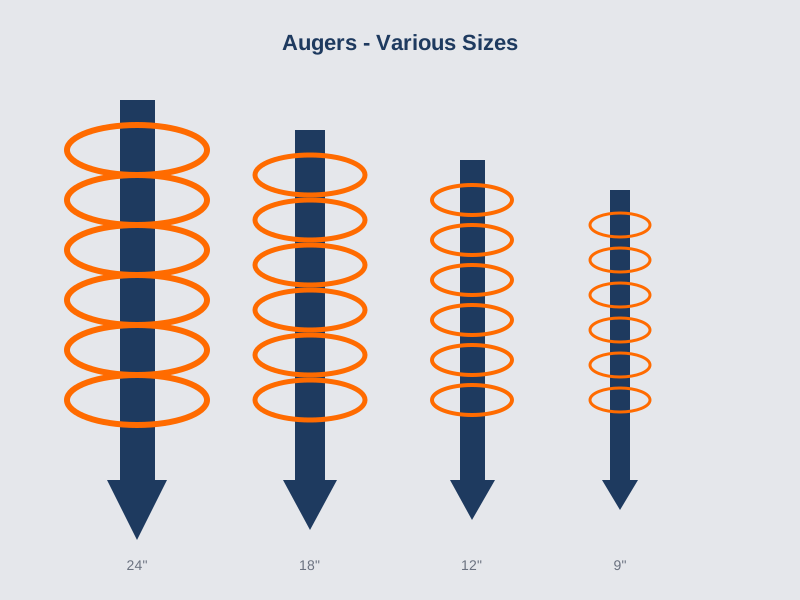
Yes, MMS augers use a standard shaft connection that fits all our post hole diggers. You can quickly swap between 9", 12", 18", or 24" augers as needed. Many farmers keep multiple sizes.
What if I need holes between 9" and 12"?
There is no 10" or 11" standard auger size. If 9" is too small and 12" is too large, use the 12" auger - it's always better to have a slightly larger hole than one that's too tight for your posts.
Which size is better for sugarcane ring pits?
Neither - sugarcane ring pits need 24-36" diameter, which requires our Ring Pit Machine. The 9" and 12" augers are not suitable for sugarcane cultivation using the ring pit method.
How much deeper can the 9" auger dig?
Both 9" and 12" augers come in the same standard length and can dig to approximately 3-4 feet depth. The depth capability is the same; only the diameter differs.
Should I buy 9" or 12" as my first auger?
For most farmers, start with 12" as it handles more applications. Only choose 9" first if you specifically do wire fencing work or have a tractor under 40 HP. You can always add a 9" later as a second auger.
Discuss Your Requirements
Our team will help you choose the right equipment.
Other Comparisons
Double DiggerVSSingle Digger (Post Hole Digger)
Double Digger vs Single Digger: Which Should You Buy?
Complete comparison of Double Digger and Single Digger to help you choose the right equipment
Hydraulic Post Hole DiggerVSMechanical (PTO-Driven) Post Hole Digger
Hydraulic vs Mechanical Post Hole Digger: Which is Better?
Complete comparison of hydraulic and mechanical post hole diggers to help you choose
MMS Post Hole DiggerVSManual Pit Digging
Post Hole Digger vs Manual Digging: ROI Analysis
Compare mechanized vs manual digging with complete cost-benefit analysis